
To improve your performance, it’s important that you estimate the right level of cardio intensity first. If, for example, you want to engage in long slow distance (LSD) endurance training, it’s important that you know exactly how fast or slow you need to run to achieve the desired effect.
Very calm workouts stimulate fat burning in your body. However, if you run too fast during this workout, it will mainly be your sugars that are burned to provide energy.
The level of intensity of your running exercises can be expressed in a number of ways. This may range from vague to highly detailed: slow, extensive, jogging, recovery run, fartlek (also known as ‘speed play’) and intensive.
You can also express this intensity in numbers, for example: 80% of your maximum speed or one kilometre in 5 minutes. The more closely the intensity of your running exercises and your training goal match each other, the more effective your workouts will be.
Heart rate as a measurement of fitness
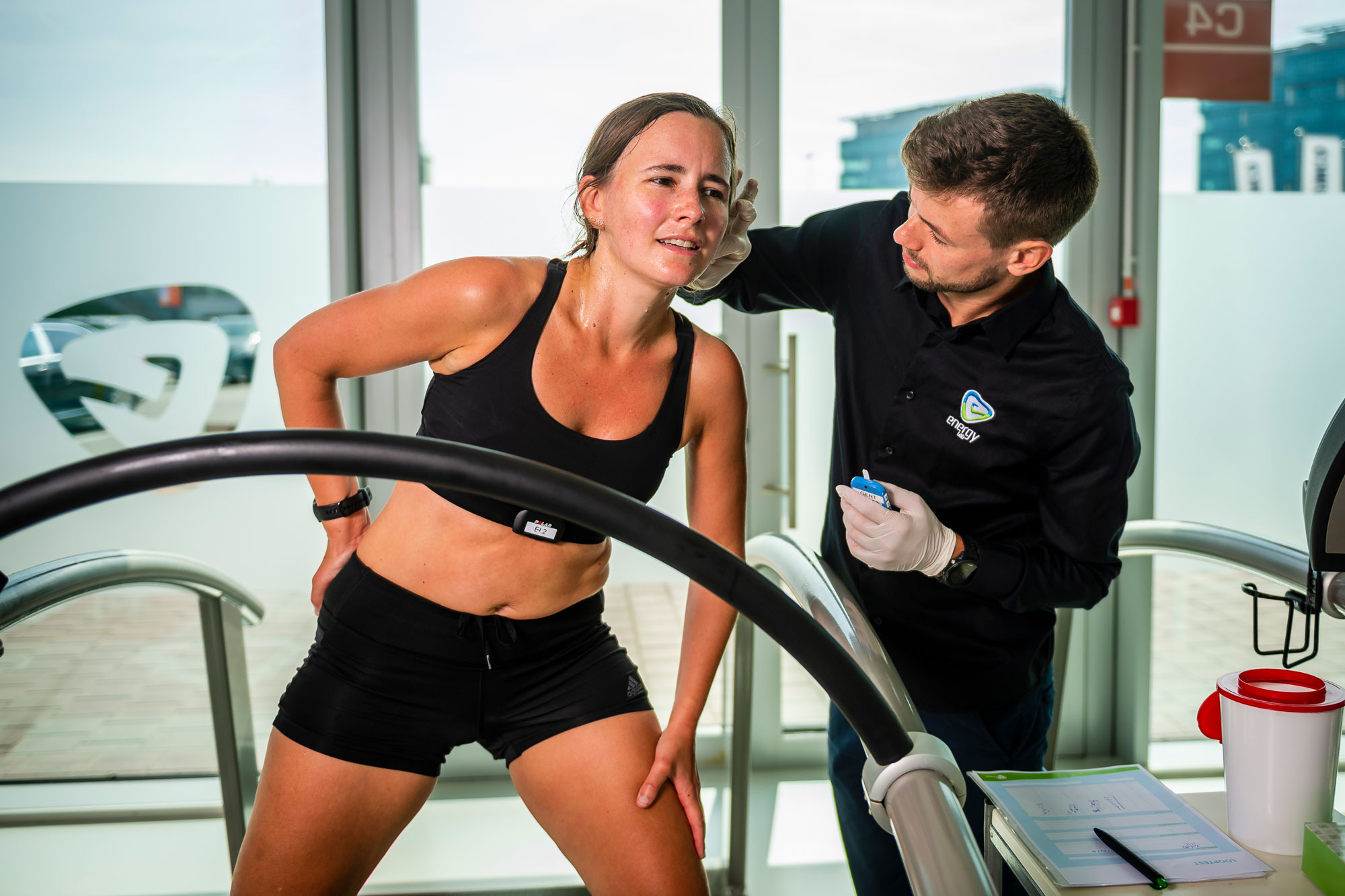
One highly efficient way to determine the intensity of your workouts is to record your heart rate during exercise. Your heart rate conveys essential information about the intensity of your workouts, as well as about your fitness levels (stamina).
Your heart rate increases in a linear fashion, in line with the intensity of your efforts. A comparison of the different heart rates measured at the same pace at different times will give you an idea of your fitness level. Once you start getting fitter, you’ll find that your heart rate will be lower when exercising at the same level of intensity. If you find that you can run faster at the same heart rate, this means your workouts have had positive results. You will also notice your fitness level has improved if your heart rate is lower after exercising.
How do you calculate your maximum heart rate?
You can calculate your heart rate based on specific percentages of your maximum heart rate. The most accurate way to check this maximum heart rate frequency is by taking a professional running test, although there are other ways to find out as well. If you go running regularly, are an athlete and are physically fit, you can determine your maximum heart rate by running at full intensity for approximately one minute – after doing warm-up exercises for at least 10 to 15 minutes, where you switch up your pace at the end.
If you don’t exercise regularly, you can also calculate your maximum heart rate by using the rule of thumb, ‘220 minus your age’. If you’re 30 years old, then, you can assume your maximum heart rate is around 190 beats per minute.
Note that this formula is somewhat flawed, as the maximum heart rate is not a reflection of your level of fitness and does not change with your training achievements. Do bear in mind, however, that you cannot, or can no longer, calculate your maximum heart rate when you’re tired. There is also the fact that your maximum heart rate (i.e. aerobic capacity) decreases with age.
As noted, you can calculate your training heart rate based on specific percentages of your maximum heart rate. However, this does depend on the type of exercise involved:
- Recovery run: -70%
- Slow endurance running (long slow distance, LSD): 70-75%
- Controlled/paced endurance running (extensive long-distance running): 76-80%
- Intensive long-distance running: 81-85%
- Tempo runs (anaerobic threshold running): 86-90%
- Fast interval run: 91-95%
- Resistance training: +95%
The advantage of this method is that it’s easy to apply, while a disadvantage is that it does not provide options for building your stamina and boosting endurance. Regardless of your fitness level, your training heart rates will remain unchanged, as your maximum heart rate does not change with training.
The Karvonen Formula
If you do want to consider your fitness level while exercising, you’re better off using the Karvonen Formula, a mathematical formula to measure your aerobic training heart rate range. In calculating your training intensity, this formula factors in your resting heart rate (resting HF) in addition to your maximum heart rate (maximum HF).
%(maximum HF – resting HF) + resting HF = HF during exercise
For example: your morning pulse rate is 50 and your maximum heart rate is 200. You want to train at 70% of your maximum intensity. In this case, your training heart rate is calculated as follows: 0.7 x (200-50)+50 = 155
Based on the Karvonen Formula, your training heart rate for the various types of training will be as follows:
- Recovery run: -65%
- Slow endurance running (LSD): 66-72%
- Paced/controlled long-distance running (extensive long-distance running): 73-76%
- Intensive long-distance running: 77-84%
- Tempo runs (anaerobic threshold running): 85-90%
- Fast interval run: 91-94%
- Resistance training: +94%
Related inspiration

CEO Gravel Challenge
What if, instead of telling CEOs how to perform sustainably, we let them experience it for themselves?
With the CEO Gravel Challenge, Golazo Energy brings together 20 CEOs and C-level leaders in a unique journey where sport becomes a laboratory for performance, leadership and teamwork.
Just like an athlete needs to train, recover, deal with pressure and rely on their team to perform at their best, the same principles apply to today’s leaders.

Golazo integrates OnTracx into its daily running practice: taking biomechanical load into account during training progression
Injuries remain one of the biggest challenges for runners, especially when training load increases faster than the body can adapt. That is why Golazo Energy is taking the next step in science-based running guidance. By integrating OnTracx into its daily running practice, runners gain deeper insight into the biomechanical load their body experiences while running. The result is a more personalised, structured and sustainable training build-up.

VO₂max over 100? Impressive… but do you actually need it?
VO₂max can sometimes seem like the number that matters most. The higher it is, the fitter you are… right? If podcasts and stories about elite athletes are anything to go by, you’d almost think anything below 70 doesn’t count. But is that really true? In this article, we put those impressive numbers into perspective. What does your VO₂max actually tell you about your fitness, how relevant is it to your goals and, more importantly, what should you really focus on if you want to become a stronger athlete?

What does a DEXA scan really measure?
A DEXA scan is often associated with measuring body fat and muscle mass. But did you know it can also provide valuable insights into your bone health, resting metabolic rate and overall body composition? Discover what a DEXA scan really measures and why it offers so much more than a standard body composition assessment.

Baloise Antwerp 10 Miles: where the course truly tests you
The Baloise Antwerp 10 Miles is a true classic but the course demands more than simply holding your pace. In this blog, we highlight where the real challenges lie and share practical tips to help you handle the tunnels, manage your rhythm and adapt to the conditions.

Leuven Marathon: why timing, pacing and courage will define your race
The Leuven Marathon is a brand-new challenge on the Belgian running calendar. With elevation changes, varied surroundings and the possibility of warmer spring conditions, this course demands more than just fitness. In this blog, you’ll discover where the real pitfalls lie and how to approach them with a smart race strategy.

Sofico Ghent Marathon: why this spring classic demands more
For many runners, the Ghent Marathon is the first major race of the spring. What looks like a flat course on paper demands more adaptability in reality. In this blog, you’ll discover the key challenges of the course and get practical tips on how to approach them smartly.

Testimonial Margo
Running a marathon doesn’t start at the start line, it starts with a smart, well-structured plan. In this testimonial, Margo shares how personalised coaching, effort testing and long-term guidance from Golazo Energy helped her complete her first marathon in her home city of Leuven, injury-free and full of confidence.

Finding the right pace for your cycling event
Taking on a gran fondo, an iconic mountain pass or a cobbled classic? Smart pacing is the secret to riding with confidence and crossing the finish line stronger. Former pro cyclist and coach Bart De Clercq shares expert tips on pacing, fuelling and course strategy.


The irresistible pull of ultra-processed foods
They’re everywhere, bright packaging, tempting flavours and perfectly portioned. Ultra-processed foods have become part of daily life, and let’s be honest: they’re hard to resist. But why is that? And what do these foods actually do to your body, your energy and your performance?






How to determine your workout intensity
This article explains how to determine the right workout intensity based on your fitness goals. By understanding your heart rate zones and calculating your maximum heart rate, you can optimize your training for better performance. It offers practical advice on adjusting your intensity to improve endurance or target specific fitness improvements.

How many years and quality of life can be gained by becoming physically fitter?
Discover how improving your physical fitness can add years to your life and enhance its quality. Studies show that regular exercise can significantly extend life expectancy and reduce the risk of diseases. Find out the benefits of becoming more physically active and how small changes can have a big impact on your health and longevity.